



AMD Ryzen AI MAX+ 395 Local LLM Inference Performance Baseline Report
#News Center ·2026-11-23 22:25:22
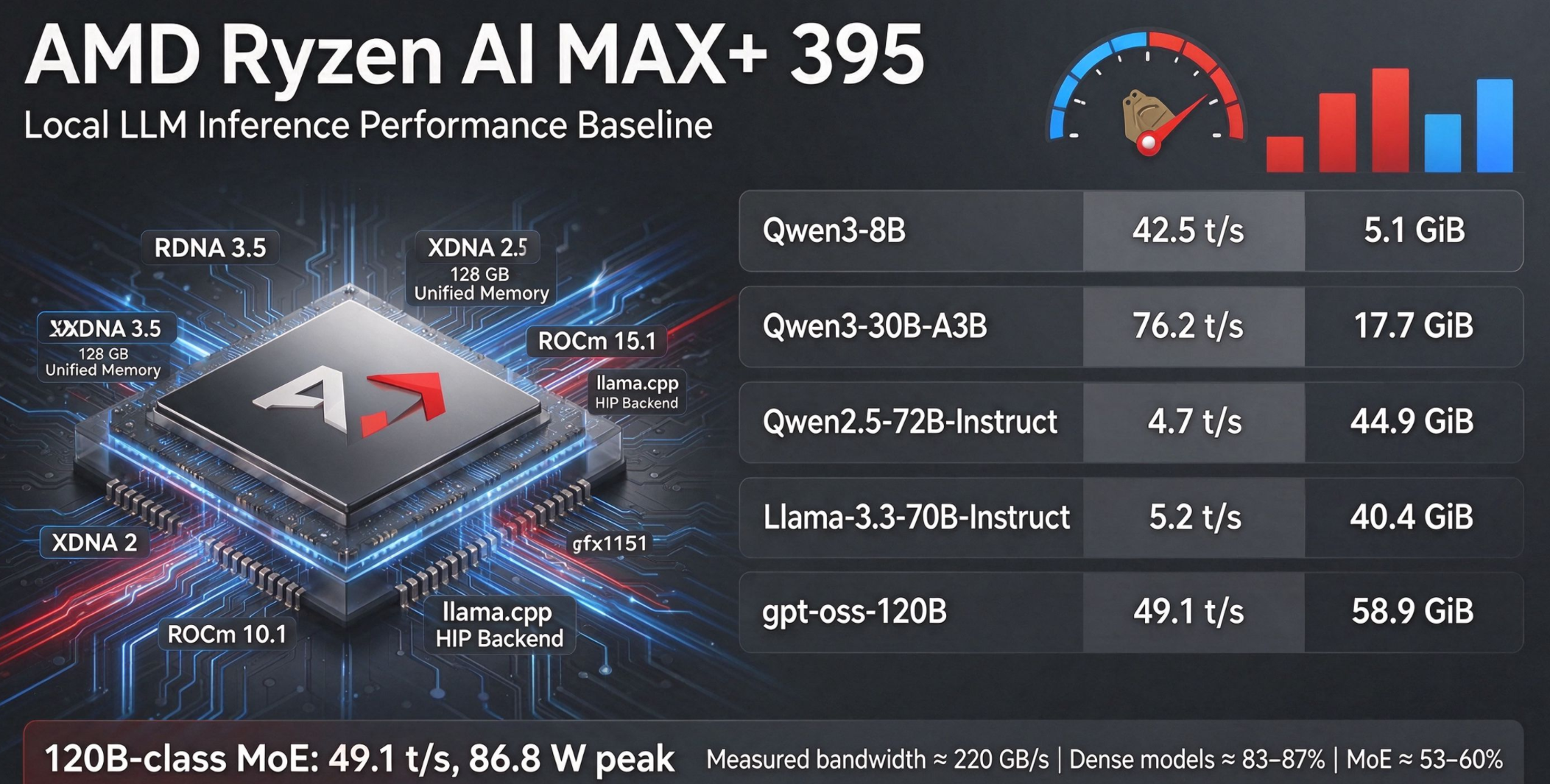
AMD Ryzen AI MAX+ 395
Local LLM Inference Performance Baseline
Report
Unified-protocol
measurement of five models under llama.cpp + ROCm
gfx1151 /
128 GB unified memory / Q4_K_M and MXFP4
Test platform: AMD RYZEN AI MAX+ 395 w/
Radeon 8060S (40 CU, 2900 MHz limit)
Test host: cyx-Default-string, Ubuntu
24.04.5 LTS, 128 GB memory
Inference framework: llama.cpp (commit f3b407c,
build b1-f3b407c, HIP backend)
Test date: November 18, 2026
Models tested: Qwen3-8B, Qwen3-30B-A3B,
Qwen2.5-72B-Instruct, Llama-3.3-70B-Instruct, gpt-oss-120B
Document version: V1.0
Contents
(Right-click here and choose
'Update Field' to generate the table of contents.)

1 Test Overview
1.1 Test Objectives
This test runs the same inference protocol
on a local host equipped with an AMD Ryzen AI MAX+ 395 processor and a Radeon
8060S integrated GPU (gfx1151), using the HIP backend of llama.cpp, against
five large models that differ in parameter count and quantisation format. It
records generation speed, context processing speed, VRAM usage, temperature and
whole-system power draw, forming a performance baseline that can be compared
across models.
The test also verifies two things: first,
whether llama.cpp can run inference stably on gfx1151 under ROCm 10.1 without
VRAM overflow or garbled output; second, whether the unified memory
architecture, with a VRAM limit of 100 GiB, can accommodate a mixture-of-experts
(MoE) model with 116.83B parameters.
1.2 Test Environment
Table 1 Test
environment and version information
|
Item |
Configuration |
|
Processor / iGPU |
AMD Ryzen AI MAX+ 395 w/ Radeon 8060S; GPU codename gfx1151 (0x1151),
40 CU, up to 2900 MHz, wave size 32 |
|
Memory |
128 GB physical, 117 GiB visible to the system; 100 GiB (102400 MiB)
of it allocated as VRAM (GTT) through kernel parameters |
|
Operating system |
Ubuntu 24.04.5 LTS (noble), kernel 7.0.0-43-generic, x86_64 |
|
Compute stack |
ROCm 10.1 (installed at /opt/rocm, actual path /opt/rocm/core-10.1) |
|
Inference framework |
llama.cpp 0.9.0-dev, commit f3b407c, build ID b1-f3b407c, HSA/HIP
backend |
|
Key kernel parameters |
amdgpu.gttsize=102400 ttm.pages_limit=26214400 (effective after these
are written to GRUB; before the reboot the VRAM limit is 60190 MiB) |
1.3 Test Protocol
All five models share one set of inference
parameters; only the generation length and the chain-of-thought switch are
adjusted to each model's characteristics, so that the speed metrics stay
comparable. All inference is executed through llama-cli, with standard input
redirected to avoid entering interactive mode and being unable to exit. The
command lines quoted later in this report are reproduced verbatim, including
the Chinese wording of the prompt, so that these runs can be reproduced
exactly; the English version of that prompt is given in Table 2.
Table 2 Unified
test parameters
|
Parameter |
Value |
Notes |
|
GPU layers (-ngl) |
99 |
All layers offloaded to the GPU |
|
Context length (-c) |
3000 tokens |
Identical context, independent of the model |
|
Generation length (-n) |
512 / 1024 / 2048 / 4096 / 6144 |
Adjusted per model, only to keep the output complete |
|
Input prompt |
Write a prose essay of about 500 words titled 'My Hometown', with
concrete scenic detail and personal memories. |
Long-form Chinese generation, also used to check output completeness
and garbled text |
|
Chain-of-thought control |
Append /no_think to the end of the prompt for the Qwen3 series |
Switches off chain-of-thought so that reasoning does not consume the
generation budget |
|
Sampling |
Framework default (no custom adjustment) |
Keeps the default behaviour |
|
Process cleanup |
pkill -9 to clear residual llama processes before each run |
GTT VRAM is not reclaimed automatically when a process exits, and
residual processes cause allocation failures |
1.4 Data Collection
Each inference run is launched by the
orchestration script bench.sh, which collects three logs in parallel within the
same time window and aggregates them when the run ends; the logs are written to
the log directory as root, after which file ownership is handed back.
The run log records the model file, file
size, context, generation length, input prompt, the full command line actually
executed, memory state, the model's raw output and the exit code. The
monitoring log samples nine metrics at 1-second intervals — CPU utilisation,
CPU temperature, memory utilisation, VRAM usage and its share, GPU utilisation,
GPU temperature and GPU clock — repeating the header every 20 rows. The power
log is taken from the PkgWatt column of turbostat, likewise sampled once per
second, and records package-level power only, so that per-core counters do not
bloat the log.
Note that the monitoring script does not
read power itself; power is collected by a separate turbostat process. The
reason is that the MSR energy counters on this platform do not read correctly,
so watts converted directly from rdmsr readings are unreliable and only
turbostat output can be used.
2 Per-Model Test Records
2.1 Qwen3-8B
Qwen3-8B is the smallest dense model in
this test, with a 4.68 GiB quantised file that stays fully resident even under
the default VRAM limit. The model carries chain-of-thought natively; in the
first round, capped at 512 tokens, the reasoning consumed the whole generation
budget and the main text was truncated. After appending /no_think to the
prompt, the output became complete.
Command executed (wrapped by bench.sh):
sudo ~/bench.sh
~/models/Qwen3-8B-Q4_K_M.gguf "Write an essay of about 500 words titled My Hometown.。/no_think"
3000 4096
llama-cli -m
/home/cyx/models/Qwen3-8B-Q4_K_M.gguf -ngl 99 -c 3000 -n 4096 -p "Write an essay of about 500 words titled My Hometown.。/no_think"
Table 3
Measured metrics for Qwen3-8B
|
Metric |
Value |
|
Model file |
Qwen3-8B-Q4_K_M.gguf (4.68 GiB / 5,027,783,488 bytes) |
|
Quantisation format |
Q4_K_M |
|
Context / generation length cap |
3000 tokens / 4096 tokens |
|
Context processing speed |
522.4 t/s |
|
Generation speed |
42.5 t/s |
|
Weight read per token |
5.03 GB (dense model, all weights take part in the computation) |
|
Effective bandwidth |
213.7 GB/s, 83.5% of 256 GB/s |
|
Peak VRAM |
5.1 GiB (5.1% of the available 100 GiB) |
|
Peak temperature |
CPU 62 degrees C, GPU 62 degrees C |
|
Peak / average power |
109.2 W / 67.5 W (26 to 34 samples) |
|
Output integrity |
Complete, no garbled text |
Model output (verbatim; translated into English for
this document):
My hometown is a small village ringed by
mountains, with four distinct seasons and scenery like a painting. There are no
tall buildings and no noisy traffic, only a winding river, so clear that its
bottom shows, threading through the village like a silver ribbon.
As a child I often played by the river,
gathering stones and chasing fish. In spring the willows on the bank put out
new buds, and the tender green branches swayed in the wind as if waving to us.
In summer the cicadas sang one after another, and my friends and I played under
the shade of the trees until the sun went down, and only then did we go home,
reluctant to leave.
In autumn the rice fields turn golden and
the air is full of the fresh scent of grain. Every household is busy with the
harvest, faces bright with the joy of a good year. In winter the snowflakes
fall quietly and the village is wrapped in white, as though it had stepped into
a fairy tale. We sat around the stove listening to grandfather tell of the old
days, warm and peaceful.
My hometown is not large, but it carries my
childhood memories and is the harbour of my heart. Whenever I drift far from
home, longing wells up in me. Its mountains, its waters and its people are the
tenderest concerns I hold.
Hometown is the place that gave me life and
raised me, the place where dreams began. Wherever I go, its scenery, its
flavours and its warmth will keep me company and become the most precious
memories of my life.
Note: a single inference run with
this model takes only about ten seconds and the GPU never reaches thermal
steady state, so the average power is pulled lower than the true steady-state
level by the idle segment; its efficiency figures are for reference only.
2.2 Qwen3-30B-A3B
Qwen3-30B-A3B uses a mixture-of-experts
architecture with 30.5B total parameters, of which only about 3.3B are
activated per token; its quantised file is 17.28 GiB. One anomaly appeared
during the test: its generation speed is nearly twice that of the previous
model, yet its memory bandwidth utilisation is clearly lower than that of a
dense model of the same generation. This difference is analysed in Chapter 3.
Command executed (wrapped by bench.sh):
sudo ~/bench.sh
~/models/Qwen3-30B-A3B-Q4_K_M.gguf "请以「我的家乡」为题目,写一篇500字左右的散文。/no_think"
3000 6144
llama-cli -m
/home/cyx/models/Qwen3-30B-A3B-Q4_K_M.gguf -ngl 99 -c 3000 -n 6144 -p "请以「我的家乡」为题目,写一篇500字左右的散文。/no_think"
Table 4
Measured metrics for Qwen3-30B-A3B
|
Metric |
Value |
|
Model file |
Qwen3-30B-A3B-Q4_K_M.gguf (17.28 GiB / 18,556,685,824 bytes) |
|
Quantisation format |
Q4_K_M (mixture of experts, 30.5B total parameters, about 3.3B
activated per token) |
|
Context / generation length cap |
3000 tokens / 6144 tokens |
|
Context processing speed |
219.3 t/s |
|
Generation speed |
76.2 t/s |
|
Weight read per token |
about 2.01 GB (scaled by the activated parameters) |
|
Effective bandwidth |
153.2 GB/s, 59.8% of 256 GB/s |
|
Peak VRAM |
17.7 GiB (17.7% of the available 100 GiB) |
|
Peak temperature |
CPU 60 to 62 degrees C, GPU 62 degrees C |
|
Peak / average power |
93.8 W / 40.5 W (24 to 30 samples) |
|
Output integrity |
Complete, no garbled text |
Model output (verbatim; translated into English for
this document):
My hometown is a small village in the
Jiangnan water country, built along the water and sleeping beside the river. In
the early morning mist wraps the flagstone paths, and the river sparkles in the
sunlight like an ink painting slowly unrolling.
Under the eaves of the houses in my
hometown bunches of red lanterns always hang; on festive days they sway gently
in the wind, as if telling old stories. When the wind passes the bamboo grove
in front of the houses it rustles, as if whispering. Every spring the bamboo
shoots break through the soil, their tender green tips pushing up the earth,
and one cannot help wanting to taste that flavour of spring.
The old people of the village often sit in
wicker chairs before their doors, drinking tea and chatting. Children chase
each other through the lanes, their laughter echoing in the quiet air. On
summer nights the stage at the head of the village comes alive, gongs, drums
and singing intertwining, as though carrying people back to older times.
What I love most is the rain of my
hometown. It is a gentle rain, fine and soft, like a mother's hand stroking the
earth. After the rain the air is especially fresh, the smell of soil mixed with
the scent of flowers, refreshing to the heart. Walking along the field ridges
you can see the new green rice seedlings swaying in the wind, as if waving to
you.
Hometown is the home of my dreams, the
softest place in my heart. Wherever I go, that water-country scenery and that
familiar scent will always be the most beautiful view in my heart.
Note: a single run with this model
takes less than ten seconds, so the power samples are few and include the
loading and idle phases; the average is clearly below the steady-state level
and its efficiency figures are not suitable for horizontal comparison.
2.3 Qwen2.5-72B-Instruct
Qwen2.5-72B-Instruct is the largest dense
model in this test, with a 44.16 GiB quantised file. It is the key sample for
verifying the unified memory architecture: weights plus KV cache take up more
than half of the available VRAM, yet no VRAM overflow or fallback to system
memory occurred at any point.
Command executed (wrapped by bench.sh):
sudo ~/bench.sh
~/models/Qwen2.5-72B-Instruct-Q4_K_M.gguf "Please write a prose of about 500 words entitled My Hometown, with specific scenery details and personal memories.。"
3000 512
llama-cli -m
/home/cyx/models/Qwen2.5-72B-Instruct-Q4_K_M.gguf -ngl 99 -c 3000 -n 512 -p
"Please write a prose of about 500 words entitled My Hometown, with specific scenery details and personal memories.。"
Table 5
Measured metrics for Qwen2.5-72B-Instruct
|
Metric |
Value |
|
Model file |
Qwen2.5-72B-Instruct-Q4_K_M.gguf (44.16 GiB / 47,415,715,488 bytes) |
|
Quantisation format |
Q4_K_M (dense model, all 72B parameters take part in the computation) |
|
Context / generation length cap |
3000 tokens / 512 tokens |
|
Context processing speed |
113.0 t/s |
|
Generation speed |
4.7 t/s |
|
Weight read per token |
47.42 GB (all weights) |
|
Effective bandwidth |
222.9 GB/s, 87.1% of 256 GB/s |
|
Peak VRAM |
44.9 GiB (44.9% of the available 100 GiB) |
|
Peak temperature |
CPU 72 degrees C, GPU 72 degrees C |
|
Peak / average power |
110.0 W / 97.9 W (216 samples, run of about 106 seconds) |
|
Output integrity |
Complete, no garbled text |
Model output (verbatim; translated into English for
this document):
Whenever the sun sets in the west, I think
of that homeland full of warmth and quiet — my hometown, a small village in
southern China. It has none of the bustle of the city, but it does have four
distinct seasons, pleasant natural scenery and honest, kindly people.
In spring everything revives. On the hills
around the village the green is lush, peach and plum blossoms open in
competition, and stretches of pink and white blossom look like a fairyland. I
remember as a child chasing and playing in that sea of flowers with my friends,
sometimes secretly picking a few of the prettiest blooms to pin in our hair,
convinced we were the most beautiful 'flower fairies' in the world.
Summer is the busiest season in the rice
fields. Endless green paddies sway in the wind like a green ocean. Towards
evening the smoke from every chimney rises slowly, the scent of rice filling
the air, making one swallow hard. Back then what my friends and I liked best
was taking a torch to the field edges to catch fireflies, watching those little
lanterns flicker in the night sky, our hearts full of boundless imagining.
Autumn is the season of harvest. Golden
rice sways in the wind and the farmers busy themselves gathering the fruit of a
year's work. Every courtyard is covered with drying grain and the whole village
is wrapped in joy. Autumn is also the season of ripe fruit: on the little
hillside by the village, pomelos and persimmons are everywhere, and the
children always go in groups to pick them and enjoy nature's gift.
Winter, though cold, seldom brings snow
here; the occasional frost instead adds a touch of mystery to the land. In
winter the thing people look forward to most is the New Year. Every household
puts up red couplets and hangs lanterns, and the whole village is dressed in
festive colour. At the New Year's Eve dinner the family sits together, tasting
the rich dishes and sharing the stories of the past year and hopes for the
next; that warmth and happiness I still cannot forget.
My hometown, a simple and beautiful place,
not only gave me the soil in which to grow but also taught me how to love and
how to cherish everything around me. Wherever I go, this will always be the
harbour of my heart and my deepest concern.
Note: this model runs for more than
100 seconds, so the GPU has reached thermal steady state and its power and
temperature data are suitable for horizontal comparison.
2.4 Llama-3.3-70B-Instruct
Llama-3.3-70B-Instruct is also a dense
model, with a 39.60 GiB quantised file, about 5 GiB smaller than the 72B.
Running with a 1024-token cap it took about 197 seconds — the longest run and
the highest temperature of the five models — and can serve as an upper-bound
check of cooling capability.
Command executed (wrapped by bench.sh):
sudo ~/bench.sh
~/models/Llama-3.3-70B-Instruct-Q4_K_M.gguf "Please write a prose of about 500 words entitled My Hometown, with specific scenery details and personal memories.。"
3000 1024
llama-cli -m
/home/cyx/models/Llama-3.3-70B-Instruct-Q4_K_M.gguf -ngl 99 -c 3000 -n 1024 -p
"Please write a prose of about 500 words entitled My Hometown, with specific scenery details and personal memories.。"
Table 6
Measured metrics for Llama-3.3-70B-Instruct
|
Metric |
Value |
|
Model file |
Llama-3.3-70B-Instruct-Q4_K_M.gguf (39.60 GiB / 42,520,398,816 bytes) |
|
Quantisation format |
Q4_K_M (dense model, all 70B parameters take part in the computation) |
|
Context / generation length cap |
3000 tokens / 1024 tokens |
|
Context processing speed |
116.5 t/s |
|
Generation speed |
5.2 t/s |
|
Weight read per token |
42.52 GB (all weights) |
|
Effective bandwidth |
221.1 GB/s, 86.4% of 256 GB/s |
|
Peak VRAM |
40.4 GiB (40.4% of the available 100 GiB) |
|
Peak temperature |
CPU 82 degrees C, GPU 82 degrees C |
|
Peak / average power |
127.9 W / 108.4 W (358 samples, run of about 197 seconds) |
|
Output integrity |
Complete, no garbled text |
Model output (verbatim; translated into English for
this document):
My hometown sits at the foot of a small
hill, surrounded by lush green trees and a winding river. Whenever I return, I
am always drawn in by the familiar scenery and smells.
My favourite season is spring. In spring my
hometown is like a beautiful painting, full of life everywhere. The trees put
out green leaves again, the flowers open, and the air is filled with a sweet
fragrance. Walking down the street you see children at play, their laughter and
shouts filling the air. The willows by the river put on their green coats too,
swaying gently in the wind.
In summer my hometown is hot. The sun on
your skin feels like a fire. We often played by the river and jumped in to cool
off. The water was so clear you could see the fish swimming. We would also sit
in the shade of the trees, eating the fruit our hometown is known for, such as
watermelons and peaches.
Autumn in my hometown is the season of
harvest. The crops ripened and the farmers were busy reaping. The air was full
of the scent of grain, and the leaves on the ground turned red, yellow and
every colour between. We often went up the hill to pick wild fruit, such as
wild pears and wild grapes.
Winter in my hometown is quiet. Snowflakes
fell softly on the earth and covered the whole world. We often built snowmen
and had snowball fights, enjoying the fun of winter.
Every time I return to my hometown I feel a
warmth and a peace. Its scenery, its smells and its tastes all feel familiar
and dear. It is the safe harbour of my heart and my home for ever.
My childhood in my hometown was a happy
one. Every day after school I went to play by the river, chasing and laughing
with my friends. We also explored the hill and found new views. On summer
evenings we would watch the stars in the yard and listen to the grown-ups tell
stories.
The changes in my hometown make me feel how
time passes. The dirt road has become asphalt, the little shop a supermarket.
Yet despite all these changes, its place in my heart has not moved. It will
always be my most beautiful hometown, the home I love most.
Every time I leave, I feel a pang of
regret. But I know I will come back, because my family, my friends and my
memories are there. My hometown will always be the place my heart belongs,
where my best memories are kept.
Note: this model ran continuously
for nearly 200 seconds, the heaviest thermal load of the test; the GPU clock
stayed at its limit throughout and no throttling was observed.
2.5 gpt-oss-120B (MXFP4)
gpt-oss-120B uses a mixture-of-experts
architecture with 116.83B total parameters, about 5.13B activated per token,
quantised to MXFP4 (about 4.25 bits per parameter), with a 59.02 GiB file. It
has to run in an environment where the VRAM limit is raised to 100 GiB: the
default 60190 MiB can hold the file size but not the weights plus KV cache, and
loading fails for lack of VRAM.
Command executed (wrapped by bench.sh):
sudo ~/bench.sh
~/models/gpt-oss-120b-MXFP4.gguf "Please write a prose of about 500 words entitled My Hometown, with specific scenery details and personal memories.。"
3000 2048
llama-cli -m
/home/cyx/models/gpt-oss-120b-MXFP4.gguf -ngl 99 -c 3000 -n 2048 -p "Please write a prose of about 500 words entitled My Hometown, with specific scenery details and personal memories.。"
Table 7
Measured metrics for gpt-oss-120B
|
Metric |
Value |
|
Model file |
gpt-oss-120b-MXFP4.gguf (59.02 GiB / 63,387,346,208 bytes) |
|
Quantisation format |
MXFP4 (mixture of experts, 116.83B total parameters, about 5.13B
activated per token) |
|
Context / generation length cap |
3000 tokens / 2048 tokens |
|
Context processing speed |
241.9 t/s |
|
Generation speed |
49.1 t/s |
|
Weight read per token |
about 2.78 GB (scaled by the activated parameters) |
|
Effective bandwidth |
136.7 GB/s, 53.4% of 256 GB/s |
|
Peak VRAM |
58.9 GiB (58.9% of the available 100 GiB) |
|
Peak temperature |
CPU 54 degrees C, GPU 55 degrees C |
|
Peak / average power |
86.8 W / 43.9 W (60 samples) |
|
Output integrity |
Complete; the reasoning is in English and the main text in Chinese,
with no garbled characters |
Model output (verbatim; translated into English for
this document):
The morning mist lay over the river like
gauze as I stood on the mottled stone arch bridge, looking at the far hills
where outlines of emerald green showed faintly through. The river rippled
gently in the breeze, and now and then a white egret skimmed past, leaving fine
trails on the water. The waterwheel below the bridge has stood still for years,
yet one can still hear the echo of its old rushing sound, as if telling of the
hardworking years of our forebears.
Following the dirt path along the bank into
the village, one meets a sea of flowering rapeseed, the golden petals shining
in the sun like a warm brocade laid over the earth. On the field ridges a few
old plum trees twist their branches, yet every year at the end of winter they
put out a pale pink, reminding me that spring never fails to arrive. I remember
chasing and playing with the neighbouring children in that sea of flowers, the
laughter of hide-and-seek drifting in the wind, so that even the old ox in the
distance would stop and look up at us in curiosity.
On summer evenings the great banyan at the
head of the village was always full of old people fanning themselves and
talking. Their voices were low and long-drawn, telling of past harvests and
hardships. On the stone bench by the roots a bowl of freshly picked wild fruit
was often left, its sweet-and-sour taste lingering. At the Mid-Autumn Festival
the village lit its long-life lamps, and the light fell on the river like
scattered beacons guiding the hearts of those coming home.
In autumn the golden waves of ripening rice
rolled across the fields, and my father and I ran between the stubble,
clutching freshly cut ears of rice and feeling the weight of the harvest. At
night the smoke rose in wisps, the scent of simmering sweet potatoes drifting
into the house, and my mother's smile looked especially gentle in the
lamplight.
My hometown has none of the noise of tall
buildings, but it has the poetry of the turning seasons and the warmth of human
feeling. Every departure is a longing for this land; every return is a coming
home of the heart. That old stone bridge, that clear river, that golden
rapeseed — they will always be the softest light and shadow deep in my memory.
Note: this model outputs an English
chain of thought by default, and its length is unstable; a 512-token generation
budget is exhausted by the reasoning, and in practice 2048 tokens cover both
the reasoning and the main text.
3 Performance Comparison and Analysis
3.1 Summary of Speed and Resource Usage
Putting the measured data of the five
models into a single table makes the source of the speed differences clear:
generation speed spans a factor of sixteen, and what determines it is not the
parameter count but how much data must be moved back and forth for each token.
Table 8 Speed
and VRAM usage of the five models
|
Model |
File size |
Context processing (t/s) |
Generation (t/s) |
Peak VRAM (GiB) |
Share of VRAM |
|
Qwen3-8B |
4.68 GiB |
522.4 |
42.5 |
5.1 |
5.1% |
|
Qwen3-30B-A3B |
17.28 GiB |
219.3 |
76.2 |
17.7 |
17.7% |
|
Qwen2.5-72B |
44.16 GiB |
113.0 |
4.7 |
44.9 |
44.9% |
|
Llama-3.3-70B |
39.60 GiB |
116.5 |
5.2 |
40.4 |
40.4% |
|
gpt-oss-120B |
59.02 GiB |
241.9 |
49.1 |
58.9 |
58.9% |
3.2 Memory Bandwidth Utilisation
Under a unified memory architecture the CPU
and GPU share the same physical memory, and the generation phase of inference
is essentially moving the weights from memory to the compute units over and
over. Multiplying generation speed by the weight read per token therefore gives
the actual bandwidth.
Table 9
Effective memory bandwidth and utilisation by model
|
Model |
Read per token (GB) |
Derived bandwidth (GB/s) |
Share of the nominal 256
GB/s |
Assessment |
|
Qwen3-8B |
5.03 |
213.7 |
83.5% |
Close to the ceiling |
|
Qwen3-30B-A3B |
2.01 |
153.2 |
59.8% |
Clearly below saturation |
|
Qwen2.5-72B |
47.42 |
222.9 |
87.1% |
Close to the ceiling |
|
Llama-3.3-70B |
42.52 |
221.1 |
86.4% |
Close to the ceiling |
|
gpt-oss-120B |
2.78 |
136.7 |
53.4% |
Clearly below saturation |
The bandwidth derived for the three dense
models is 213.7, 221.1 and 222.9 GB/s, within 4% of one another. This is no
coincidence: three models of different scale returning the same figure shows
that the bottleneck has moved to the hardware side rather than the model side,
with no extra architectural loss in the backend. That figure can be taken as
the measured bandwidth ceiling of this platform, roughly 86% of the nominal 256
GB/s.
From this comes a practical rule of thumb:
running a dense model on this machine, generation speed is approximately 220
divided by the weight read per token in GB. Checking it: for 72B, 220 divided
by 47.42 gives about 4.6 t/s, broadly consistent with the measured 4.7 t/s; for
8B, 220 divided by 5.03 gives about 43.7 t/s, consistent with the measured 42.5
t/s.
3.3 Backend Bottleneck of Mixture-of-Experts Models
The two mixture-of-experts models break
sharply from the dense models: Qwen3-30B-A3B reaches 59.8% and gpt-oss-120B
53.4%, both below sixty percent. Their parameter counts differ nearly fourfold
and their quantisation formats differ as well, yet they settle at the same
level, which shows the common cause is not the models themselves.
The reasonable explanation lies in expert
routing. For each token generated, a mixture-of-experts model activates only a
few experts, but the weights of those experts are not contiguous in the file:
they must be gathered from several locations according to the routing result
and scattered back after computation. A dense model performs one large
contiguous read, which lets hardware prefetching and memory coalescing do their
work. On gfx1151, this layer of gather and scatter does not yet overlap with
computation, so the iGPU is in effect waiting on kernel scheduling rather than
on data. That is why bandwidth utilisation stands at only sixty percent.
It follows that the speeds measured here
are not the ceiling of this hardware. If mixture-of-experts models could also
reach the 85% level of dense models, extrapolating at the same bandwidth, 120B
should reach about 77 t/s and 30B-A3B about 108 t/s, leaving more than forty
percent headroom. That headroom can only come from the backend; adding memory
or changing machines will not deliver it.
3.4 Power and Temperature Characteristics
Power does not scale linearly with model
size but correlates strongly with the inference phase. The context processing
phase is matrix multiplication, dense in compute, and can briefly push
whole-system power to about 139 W — the only condition that approaches the
cooling limit. The generation phase is bandwidth-bound and the compute units
spend most of their time waiting for data, with peaks of only 87 to 128 W.
As for temperature, the longest continuous
run, Llama-3.3-70B, reached 82 degrees C, the highest of the five;
gpt-oss-120B, which ran only about twenty-odd seconds, reached just 55 degrees
C. Across all monitoring logs the GPU clock stayed at its limit throughout and
no thermal throttling occurred, showing that the cooling capability of this
machine is sufficient for all the workloads above.
It should be noted that Qwen3-8B and
Qwen3-30B-A3B run for only ten-odd or even under ten seconds per run, so the
GPU never reaches thermal steady state and the average power is pulled down by
the loading and idle phases; the power and efficiency data of these two models
cannot be compared directly with those of the long-running models.
3.5 Efficiency Comparison
Dividing generation speed by peak power
gives an approximation of energy efficiency that as far as possible excludes
the influence of run duration. Taking the dense models' level of about 0.04 as
the baseline, the mixture-of-experts models are thirteen to nineteen times more
efficient.
Table 10
Efficiency comparison by model (generation speed divided by peak power)
|
Model |
Generation speed (t/s) |
Peak power (W) |
Efficiency (tokens/s/W) |
Relative to dense models |
|
Qwen3-8B |
42.5 |
109.2 |
0.39 |
about 9x |
|
Qwen3-30B-A3B |
76.2 |
93.8 |
0.81 |
about 19x |
|
Qwen2.5-72B |
4.7 |
110.0 |
0.043 |
baseline |
|
Llama-3.3-70B |
5.2 |
127.9 |
0.041 |
baseline |
|
gpt-oss-120B |
49.1 |
86.8 |
0.57 |
about 13x |
gpt-oss-120B is the best all-round solution
in this test: 62% more parameters than 72B, 10.4 times its generation speed,
and 21% lower peak power and 17 degrees C lower temperature. This shows that on
this platform a mixture-of-experts model is not a compromise but a clearly
better choice than a dense model of comparable file size.
4 Conclusions and Recommendations
4.1 Main Conclusions
(1) The measured memory bandwidth of this
platform is about 220 GB/s, equal to 86% of the nominal 256 GB/s. The bandwidth
utilisation of the three dense models (8B, 70B, 72B) is tightly clustered
between 83% and 87%, which shows that the combination of ROCm and gfx1151
carries no extra architectural loss on dense models.
(2) The bandwidth utilisation of the
mixture-of-experts models is generally only 54% to 60%, some 30 percentage
points below the dense models. This gap lies at the level of the backend
implementation, mainly because the gather and scatter of expert weights do not
overlap with computation, leaving more than forty percent of the performance
headroom unreleased.
(3) After raising the VRAM limit from the
default 60190 MiB to 102400 MiB, a 116.83B-parameter model with a 59.02 GiB
file can stay fully resident in VRAM, peaking at 58.9 GiB with about 41%
headroom. This is the only precondition that made it possible to run a
120B-class model in this test.
(4) Under the same power budget,
mixture-of-experts models are an order of magnitude more efficient than dense
models. On this machine, a 120B-class mixture-of-experts model beats 70B to
72B-class dense models on speed, energy consumption and temperature at the same
time.
4.2 Selection Recommendations
Table 11 Model
selection recommendations by use case
|
Use case |
Recommended model |
Rationale |
|
Highest output quality required, some latency acceptable |
gpt-oss-120B |
Largest parameter count; 49.1 t/s still allows interaction; the
largest VRAM headroom |
|
High-throughput or low-latency concurrency required |
Qwen3-30B-A3B |
76.2 t/s, the highest of the five; only 17.7 GiB of VRAM, so multiple
instances can run in parallel |
|
Size-constrained, edge deployment or lightweight secondary
development |
Qwen3-8B |
4.68 GiB, 42.5 t/s, the lowest loading and switching cost |
|
Chinese long-form writing, offline batch processing |
Qwen2.5-72B or Llama-3.3-70B |
Stable output, but about 5 t/s suits offline tasks only |
|
Long context above 8000 tokens required |
gpt-oss-120B |
At 58.9 GiB of usage, about 41 GiB remains for the KV cache |
4.3 Directions for Further Optimisation
First, prioritise backend optimisation on
the mixture-of-experts path. The current 53.4% for 120B and 59.8% for 30B-A3B
are clear weak spots; options worth trying include enabling Flash Attention,
tuning the expert batching and tensor coverage strategy, comparing different
versions of llama.cpp, and, where conditions allow, evaluating other ROCm
inference frameworks.
Second, run a separate round of
long-context testing. gpt-oss-120B uses only 58.9 GiB at a 3000-token context;
extrapolating linearly, 16000 tokens would need about 3 GiB more KV cache,
still within the limit, and this is worth verifying by measurement.
Third, add steady-state efficiency tests.
The single runs of 8B and 30B-A3B are too short, and the model ends by itself
once the instruction is completed, so merely raising the generation length cap
does not lengthen the run. To obtain credible steady-state power, one should
repeat a benchmark with a fixed token count several times in succession, with a
background monitoring process covering the whole time window.
Fourth, if higher output quality is needed,
try Q5 or Q6 quantised versions of 120B. Q6_K is about 90 GiB, close to the 100
GiB limit but still resident; the cost is higher bandwidth demand and lower
generation speed, which must be weighed by measurement.
Appendix A
Reproduction Commands
A.1 Raising the VRAM Limit
Under the default configuration the VRAM
limit is 60190 MiB, about 50% of physical memory, which cannot hold a
120B-class model. It must be set explicitly on the kernel command line and
takes effect after a reboot. Changing the pages_limit parameter at runtime does
not change the total, because the VRAM size is already fixed during driver
probing.
sudo cp /etc/default/grub
/etc/default/grub.bak
sudo sed -i
's|^GRUB_CMDLINE_LINUX_DEFAULT="|GRUB_CMDLINE_LINUX_DEFAULT="amdgpu.gttsize=102400
ttm.pages_limit=26214400 |' /etc/default/grub
sudo update-grub &&
sudo reboot
~/llama.cpp/build/bin/llama-bench
-m /dev/null 2>&1 | head -3
After the reboot the VRAM should read
102400 MiB. If it still shows 60190 MiB, the parameters did not reach the
kernel command line; check with cat /proc/cmdline.
A.2 Monitoring Script
The monitoring script prints nine metrics
at a fixed interval; its parameters are the refresh interval in seconds and the
number of rows between repeated headers, defaulting to 1 second and 20 rows.
~/watch.sh 1 20
A.3 Orchestration Script
The orchestration script clears residual
processes, launches the inference, collects the three logs in step and produces
the summary. Its parameters are the model path, the input prompt, the context
length and the generation length. Because power collection relies on turbostat,
the script must be run with sudo.
sudo ~/bench.sh
~/models/gpt-oss-120b-MXFP4.gguf "Please write a prose of about 500 words entitled My Hometown。"
3000 2048
Appendix B List of
Log Files
All logs are kept in the bench-logs
directory under the user's home directory; each run of each model produces
three files, distinguished by model name and timestamp.
Table B.1
Description of log files
|
File prefix |
Content |
Purpose |
|
run- |
Model size, context, generation length, prompt, full command line,
raw output, summary metrics |
Main basis for reproduction and auditing |
|
watch- |
Second-by-second samples of the nine system metrics |
Observation of load curves and temperature changes |
|
power- |
Second-by-second samples of turbostat PkgWatt |
Statistics of peak and average power |
Appendix C Known
Issues and Limitations
First, the Qwen3 series and gpt-oss-120B
emit chain-of-thought by default, which exhausts the budget first when the
generation length is insufficient, truncating the main text. For Qwen3,
/no_think can be appended to the prompt; for gpt-oss, the generation length
must be raised above 2048 tokens. This behaviour has nothing to do with model
capability and only with the allocation of the generation budget.
Second, the power samples for 8B and
30B-A3B are too few. Both infer so fast that a single run yields only
twenty-odd sample points, and these include the loading and exit phases, so
their power and efficiency figures can only serve as an indication of trend.
Third, the per-token read of the
mixture-of-experts models is derived from the activated parameters; it is a
theoretical estimate that does not count the memory traffic of attention-layer
weights and the KV cache, so its bandwidth figures carry some error. For dense
models the read equals the measured file bytes, so the error is small.
Fourth, the context length in this test is
a uniform 3000 tokens and does not cover long-context scenarios. The KV cache
overhead, the growth of attention computation and the drop in speed that come
with longer contexts need to be assessed in a separate long-context test.